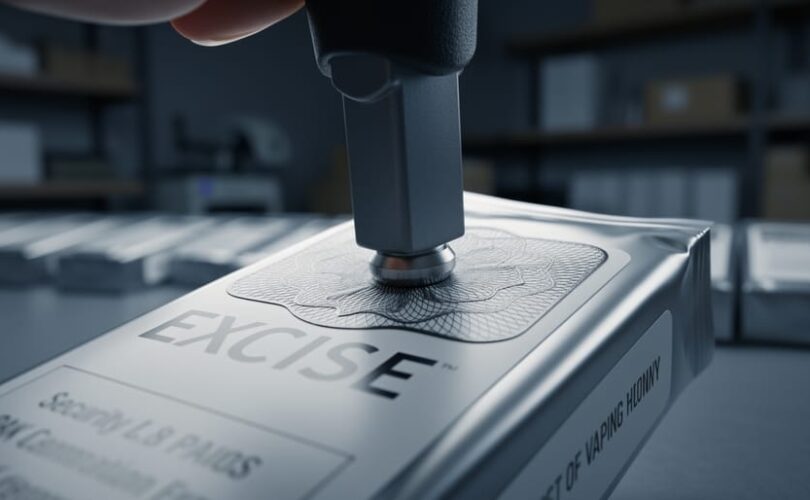
An excise stamp in Canada is a mark the Canada Revenue Agency (CRA) uses to show that excise duty has been accounted for on a packaged vaping product. If you’re wondering what that means for you, the short version is this: the stamp is part of how the duty-paid vaping market is tracked, and the rules behind it changed in 2026.
Here’s what’s confirmed. The CRA is the agency responsible for vaping excise stamps. It updated its vaping excise stamps notice in March 2026, and that notice says the amendments came into force on February 26, 2026. The big change for provincial rules is that Nova Scotia has been added to the list of specified vaping provinces. That addition lines up with Memorandum D18-3-2, “Excise duty framework for vaping products,” which reflects that Nova Scotia has entered into coordinated vaping taxation agreements.
Who do these rules actually apply to? Mainly industry. The notice is aimed at vaping product licensees who manufacture or import packaged vaping products for stamping in Canada, and at vaping prescribed persons who import stamped, packaged products for the duty-paid market. If you’re an adult who switched from smoking and just wants to know what that stamp on your product means, this guide breaks it down in plain language, one step at a time.
What Is an Excise Stamp in Canada, in Plain English?
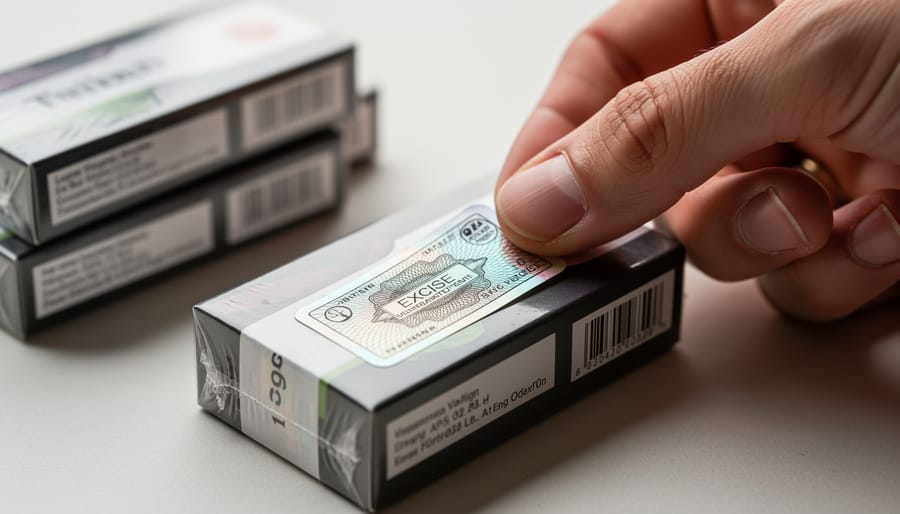
If you’ve picked up a vape lately, you might have noticed a small stamp on the packaging. It’s easy to ignore, but it tells you something real about where that product sits in the legal market.
An excise stamp is a marker applied to a packaged product to show that the required excise duty has been accounted for. Think of it like a receipt stuck right on the box. Instead of asking you to trust that the paperwork was handled, the stamp shows it was.
Governments use stamps for a simple reason: tracking. When products carry a visible marker, it’s easier to tell which ones belong to the legal, duty-paid market and which don’t. In Canada, the Canada Revenue Agency (CRA) is the body responsible for vaping excise stamps. Any vape excise duty that applies to a product is handled through that system, not by you at the checkout counter.
A few terms come up again and again in this topic, so here they are in plain language:
- Excise duty
- A tax charged on certain products, collected as part of the regulated system rather than being a simple sales tax at the till.
- Excise stamp
- A marker on a package showing that the required excise duty has been accounted for.
- Duty-paid market
- The legal market of products for which the required duty has been dealt with, as opposed to products that skipped the system.
- Licensee
- A business licensed under the framework, for example one that intends to manufacture or import packaged vaping products for stamping in Canada.
- Packaged vaping product
- A vaping product sold in its finished retail packaging, which is the kind of product the stamp is applied to.
You don’t need to memorize any of this to shop confidently. The big picture is easy to hold onto: the stamp is a visible sign that a product is part of the regulated, duty-paid system. The rest of this guide covers who runs that system and what has changed recently.
Who Is in Charge? The CRA and the Rules Behind the Stamps

The Canada Revenue Agency (CRA) is the body responsible for vaping excise stamps in Canada. If you’ve ever wondered who actually sets up and oversees the stamp system, that’s your answer. It’s a federal agency doing this work, and it publishes its guidance for anyone who wants to follow along.
The main reference document is Memorandum D18-3-2, titled “Excise duty framework for vaping products.” It’s dated Ottawa, March 10, 2025, and it lays out how the framework works.
Not sure what a memorandum is? Think of it as an official explainer. It’s not a news story or a blog post. It’s a document an agency uses to describe how a set of rules operates and how it applies them. So when questions come up about the stamp system, this is where the CRA’s own explanation lives.
Why bother reading it? If you like understanding the “why” behind the rules, or you simply want to keep up with legal changes, going to the source is a great habit. Official documents can feel dense at first, but reading them yourself means you’re not relying on secondhand summaries, which can get things wrong or go out of date.
The memorandum also touches on the provincial side of things. It says its updates reflect that Nova Scotia has entered into coordinated vaping taxation agreements. We’ll look at that more closely a little later.
A quick tip: since the CRA updates its materials, check its current versions for the latest wording before you rely on anything you’ve read elsewhere, including here.
Key Details: What Changed in 2026
Here’s the short version of what changed this year, laid out so you can scan it quickly. If you want the bigger picture on how these rules fit together, our guide to vaping regulations explained is a good companion read.
| Item | Verified detail | What it means for readers |
|---|---|---|
| CRA notice update | The Canada Revenue Agency updated its vaping excise stamps notice in March 2026. | The official wording was refreshed, so the CRA’s current notice is the place to confirm details. |
| In-force date | The notice says the amendments came into force on February 26, 2026. | The changes are already in effect, not something coming down the road. |
| Nova Scotia addition | Nova Scotia was added to the list of specified vaping provinces. | The province is now part of the provincial stamp picture. |
| Memorandum D18-3-2 | “Excise duty framework for vaping products,” dated Ottawa, March 10, 2025. | This is the reference document behind the framework, and it ties the Nova Scotia update to coordinated vaping taxation agreements. |
Here’s what that means in everyday language. The CRA reworked its notice in March 2026, and the notice itself says the amendments took effect on February 26, 2026. So the update came after the changes were already in force, which is common with regulatory paperwork.
The headline change is Nova Scotia joining the list of specified vaping provinces. Memorandum D18-3-2 explains that its updates reflect Nova Scotia entering into coordinated vaping taxation agreements. That’s the “why” behind the addition.
It’s also worth remembering who the notice is written for: vaping product licensees that manufacture or import packaged products for stamping in Canada, and prescribed persons that import stamped, packaged products for the duty-paid market. If you’re an adult vaper, you won’t be filling out any of this yourself.
One more thing: we’re only sharing what’s confirmed here. We aren’t adding rates, deadlines, or other specifics that haven’t been verified, so check the CRA’s current notice for the latest wording before relying on any detail.

Why Provinces Matter: Nova Scotia and Coordinated Vaping Taxation
Here’s where the provincial piece comes in. The CRA’s notice doesn’t just talk about vaping stamps in general terms. It refers to “specified vaping provinces,” and in the March 2026 update, Nova Scotia was added to that list. If you follow regulation news, that’s one of the more concrete changes to know about.
Why does it matter? Memorandum D18-3-2 explains that its updates reflect Nova Scotia entering into coordinated vaping taxation agreements. In plain language, “coordinated” suggests the federal and provincial sides are working together on how vaping products are taxed, rather than each handling it entirely on its own. That’s the extent of what the memorandum tells us, so there’s no need to read more into it than that.
It’s worth being clear about what we don’t know. The materials we’re working from don’t describe how any other province approaches this, and they don’t give specific amounts, so any claims about those details would just be guesswork. What we can say is that a province’s inclusion on the list is meaningful, and that the list can change over time, as this update shows.
This kind of shift is part of the bigger picture of regulatory change and its impact on industry. For most adult vapers, none of it means doing anything differently on a given day. But it does show why staying informed is a good habit, especially if you’re newer to vaping and still getting your bearings.
So what’s the practical step? Take a few minutes to look up the rules in your own province. Local requirements can differ from one place to the next, and your provincial government’s website is the best place to confirm what applies where you live. For the federal side, the CRA notice and Memorandum D18-3-2 are the sources to check for the most current wording.
Who the Stamp Rules Apply To
If you’ve been wondering whether the stamp rules land on your shopping cart, the short answer is no. The CRA notice is written for people who work in the vaping supply chain, not for the adult buying a device or a bottle of e-liquid at the counter.
Here’s who the notice is actually addressed to:
- Vaping product licensees that intend to manufacture or import packaged vaping products for stamping in Canada.
- Vaping prescribed persons that import stamped, packaged vaping products for the duty-paid market.
- Not directly aimed at everyday adult vapers who simply purchase products from a retailer.
Think of it as a division of labour. A licensee is a business that has taken on the job of getting packaged vaping products stamped, whether they’re made here or brought in from elsewhere. A prescribed person comes in at a different point, importing products that are already stamped and packaged so they can be sold in the duty-paid market. Both are part of the behind-the-scenes machinery that keeps the legal market tracked.
If you run or work with a business like this, the details matter, and it’s worth getting compliance help when you’re sorting out where your operation fits. The notice itself, along with Memorandum D18-3-2, is the place to confirm the exact wording of who qualifies and what’s expected.
For the rest of us, the takeaway is simpler. You aren’t the one applying stamps or filing paperwork. You’re just the person who benefits when the products on the shelf have gone through the proper channels.
Insider perspective (coming soon): We’d love to feature an industry expert here, someone who handles licensing or importing day to day, to explain how stamping works in practice. If you work in this space and want to share what the process really looks like, we’d welcome the conversation.
What This Means for You as an Adult Vaper
The stamp rules are written for licensees and importers, not for you. Still, you can use what they tell us in a few simple ways.
First, buy from reputable, licensed retailers. The CRA’s vaping excise stamps notice covers products meant for the duty-paid market, so a shop that sources from that legitimate supply chain is a much safer bet than a seller who can’t tell you where their stock comes from. If a deal looks too good to be true, it probably is.
Second, take a moment to look at the package. Check whether it carries the stamp your province expects. I can’t tell you exactly what it looks like in every province, and designs can differ, so ask the retailer to show you what a compliant product should have. A good shop won’t mind the question.
Third, stay informed. The CRA updated its notice in March 2026, and the amendments came into force on February 26, 2026. Rules shift, and your province may change things too, so it’s worth checking the CRA’s current notice every so often.
Here’s an illustrative example, not a real person’s story. Picture an adult who finally put cigarettes behind them and switched to vaping. At first, they grabbed whatever was cheapest from wherever was handiest. Then they started reading up on the rules, got curious about the stamp, and began asking shops simple questions about where their products came from. Within a few weeks, they were buying only from retailers who could answer clearly. They felt more confident, not more stressed.
If you’re still weighing your options, it can also help to read about some alternatives to vaping so you can make the choice that fits your goals.
Common Questions About Vape Excise Stamps in Canada
Here are quick answers to the questions readers ask most. Keep in mind that these cover only what’s been confirmed, so for anything more specific, the official sources are your best bet.
Who is responsible for vape excise stamps in Canada?
The Canada Revenue Agency (CRA) is responsible for vaping excise stamps. Its framework is laid out in Memorandum D18-3-2, “Excise duty framework for vaping products.”
When did the 2026 amendments come into force?
The CRA’s updated notice, published in March 2026, says the amendments came into force on February 26, 2026.
Which province was added to the list?
Nova Scotia was added to the list of specified vaping provinces. The memorandum explains that this reflects Nova Scotia entering into coordinated vaping taxation agreements.
Who does the CRA notice apply to?
It’s aimed at vaping product licensees that manufacture or import packaged vaping products for stamping in Canada, and at vaping prescribed persons that import stamped, packaged products for the duty-paid market.
So does any of this change how you shop? The notice is written for industry participants, not for everyday adult vapers picking up a pack. As a consumer, you don’t have to file anything or interpret the rules yourself. What you can do is stick with reputable, licensed retailers and stay curious about how the legal market works.
For the exact wording of the rules, go straight to the source. The CRA’s vaping excise stamps notice and Memorandum D18-3-2 are the places to check for current details, and they’re worth a look any time you want to confirm something rather than rely on secondhand summaries.
To pull it all together: the Canada Revenue Agency is the body responsible for vaping excise stamps, and its framework is laid out in Memorandum D18-3-2, “Excise duty framework for vaping products.” In March 2026, the CRA updated its notice to add Nova Scotia to the list of specified vaping provinces, with the amendments coming into force on February 26, 2026. That update reflects Nova Scotia’s coordinated vaping taxation agreements.
It’s also worth remembering who the rules are really aimed at. The notice speaks mainly to vaping product licensees and vaping prescribed persons, the businesses that manufacture or import packaged products for the duty-paid market. As an everyday adult vaper, you’re not the one filing paperwork.
Still, staying informed pays off. Buying from reputable, licensed retailers and paying attention to the stamp on your packaging is a simple way to support the legal market. If you’re moving away from smoking, that kind of awareness is a solid habit to build, and it keeps your switch grounded in compliant, responsible choices.
Rules change, and the details matter, so check the CRA’s official notice and Memorandum D18-3-2 for the latest wording before you rely on anything you’ve read here, this guide included.